


Abortions with fever: look at the sow's blood
by Sebastiaan Theuns
Sample type
Serum, pool of 4 sows (second parity) with fever and abortion.
Case discussion
In the summer of 2025, a sow herd in the Netherlands saw several second-parity sows abort, and the affected sows also had fever. Diagnostics was performed to exclude influenza A virus and PRRSV, but results returned negative. Also, the disease moved rather slowly through the barn, which is rather atypical for both mentioned viruses. So the veterinarians suspected something else was in the game. Given the lack of lesions in the fetuses, the veterinarian suspected a cause in the sow. Rather than only sampling the fetuses, the veterinarian thus also collected serum from four affected sows and sent a pool for PathoSense analysis.
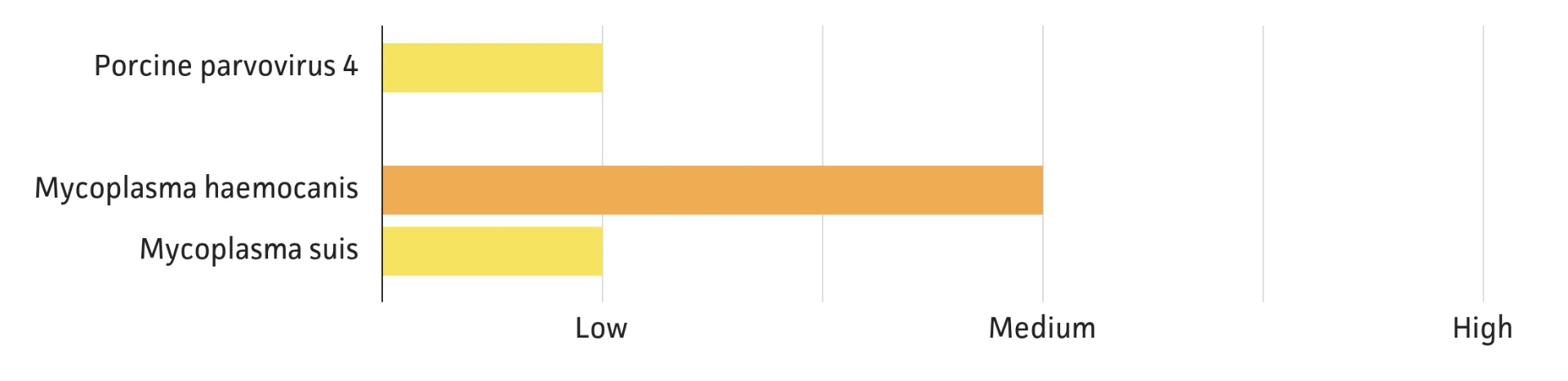
The serum revealed the presence of two haemotropic mycoplasma species. Mycoplasma suis was present at a low load, and a second haemoplasma was detected at a medium load, with its closest match being Mycoplasma haemocanis. Yes, a dog's mycoplasma on a pig report: we looked twice too. Three haemoplasma species are known in pigs, M. suis, M. parvum and "Candidatus Mycoplasma haemosuis", and the last one belongs to the same group as M. haemocanis (Ade et al., 2024). This was likely a very closely related Mycoplasma species, but further in-depth characterisation was not possible.
Haemotropic mycoplasmas attach to red blood cells. M. suis causes infectious anaemia in pigs, and in sows dysgalactia, reproductive cycle disorders and abortion have been described (Ade et al., 2024). None of them are part of the pathogen panel that is routinely tested on abortion material in central Europe (Bischoff et al., 2026), and they live in the sow's blood. Porcine parvovirus 4 was also found at a low load. Its role in reproductive failure is not clear, so we read it as a finding to keep an eye on, not as the cause. Parvoviruses often circulate in the blood, and they replicate in actively dividing immune cells.
The veterinarian was able to get the situation under control by a targeted treatment with antibiotics. This led to a control of the reproductive problems. The lesson for the next abortion cluster: when sows abort with fever or look pale, sample the sow as well as the fetus.
Read the litter before you sample
In an abortion case, the aborted litter already tells you where to look. Our Sample Selection Guide sorts abortions in pigs into three pictures, each with its own sample.
🟤 Fetuses of different sizes (SMEDI suspected) Varying sizes of the fetuses or piglets point to an infection that spread inside the uterus, such as porcine parvovirus 1, PCV2 or EMCV. Pick at least 3 well-chosen fetuses, preferably the smaller brownish ones, and larger mummies. Skip the largest fetuses: those may already carry antibodies that interfere. Take small pieces of lung, heart and spleen and pool them into one analysis.
🫀 Late-term abortion or weak, premature piglets (PRRSV suspected) Sample the thymus and the umbilical cord, where viral loads are highest. PRRSV does not cause SMEDI.
🐖 Fetuses all the same size They were likely expelled at the same moment, and fetal material gives a low diagnostic yield. Sample the sow instead: serum from affected sows, during the fever if you can, pooled from at most 5 animals. Send the serum as it is, without processing it with the swab; you only use the kit to register the sample with its barcode. That is the route the veterinarian took in this episode's case. Check environmental stressors as well. Important note: if the piglets are rigid, they went into rigor mortis. That means they were expelled alive, and the problem should be found in the sow.
Want to discuss your own abortion and respiratory cases? Join our free session on swine diagnostics with Prof. Guillermo Ramis on Thursday 29 October, 16:00 CET.
Retrospective analysis of infectious agents in swine abortion materials in the years 2021 to 2023
Bischoff H, Beumer M, Helmer C, Spiekermeier I, Buch JM, Hundehege C, Menke T, Humann-Ziehank E, Hennig-Pauka I. 2026.
Veterinary Research Communications
The authors went through 199 abortion cases (fetuses and placentas) submitted to a German diagnostic lab between 2021 and 2023. Most cases were tested for the same key panel: PRRSV, Chlamydiaceae, PCV2, porcine parvovirus and Leptospira. At least one of these was found in only 38 of the 199 cases (19.1%), with PRRSV and Chlamydiaceae most frequent, and including other methods a likely pathogen turned up in 24.6% of cases. The authors expect that a broader diagnostic approach will detect more pathogens that routine PCR does not test for. A useful benchmark for anyone who has received a negative panel after an abortion storm.